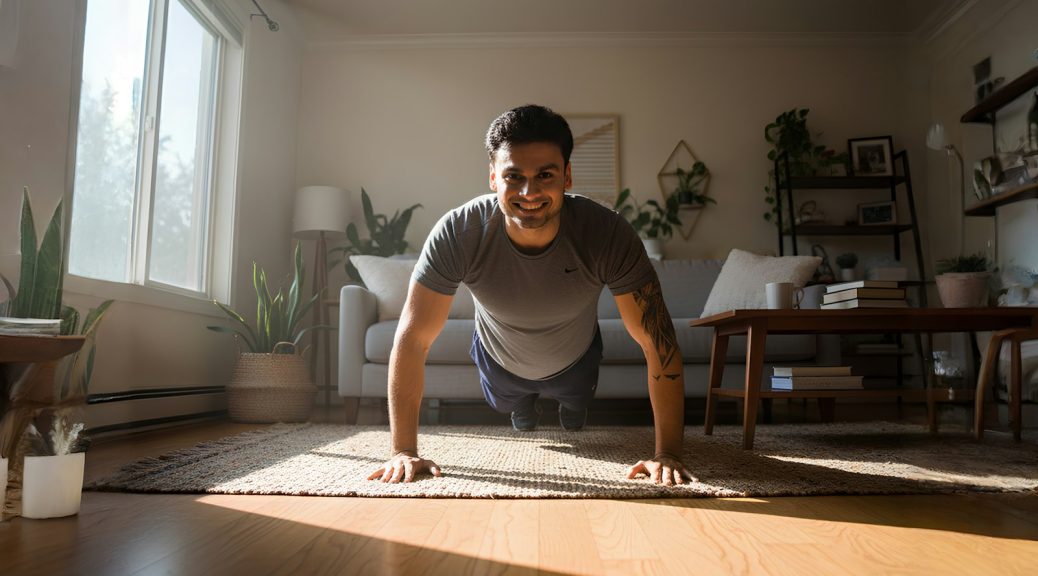
No gym, no equipment and no complicated moves. Five exercises, done twice a week, cover the muscle-strengthening part of the guidelines.
Quick points
- Australia’s movement guidelines recommend muscle-strengthening activities on 2 or more days a week.
- Bodyweight exercises such as squats, push-ups and glute bridges work the major muscle groups without equipment.
- Start with the easier versions and focus on good form before adding repetitions.
- Warm up for about five minutes first, and stop if you feel sharp pain.
Strength training doesn’t have to involve a gym. Your own bodyweight is enough to build strength when you’re starting out, and a short routine at home is easy to fit into a busy week.
Australia’s 24-hour movement guidelines recommend muscle-strengthening activities on 2 or more days a week for adults. This workout is one way to do that.
Before you start
Warm up for about five minutes with marching on the spot, arm circles and a few gentle squats. Our guide to warming up explains why it helps.
The workout
Do each exercise for the number of repetitions shown, rest for 30 to 60 seconds, then move to the next. Complete the whole circuit two or three times.
| Exercise | Easier version | Standard version | Reps |
|---|---|---|---|
| Squat | Sit-to-stand from a chair | Bodyweight squat | 8–12 |
| Push-up | Wall push-up | Push-up on knees or toes | 6–12 |
| Glute bridge | Smaller range of movement | Full bridge with a 2-second hold | 10–12 |
| Reverse lunge | Hold a chair for balance | Alternate legs without support | 6–10 each leg |
| Plank | On knees | On toes | Hold 15–30 seconds |
Getting the form right
- Squat: feet about shoulder-width apart, sit back as if onto a chair, and keep your chest up and your knees in line with your toes.
- Push-up: keep your body in a straight line from head to heels (or knees) and lower your chest towards the floor or wall with control.
- Glute bridge: lie on your back with your knees bent, press through your heels and lift your hips until your body forms a straight line from shoulders to knees.
- Reverse lunge: step one foot back and lower until both knees are bent to about 90 degrees, then push back up.
- Plank: elbows under your shoulders, body straight, breathing steadily.
Training tip
Choose a version of each exercise you can do with good form for the whole set. When the last few repetitions feel easy, move up to the harder version or add a few more reps.
How to progress
After a few weeks, make the workout a little harder by adding repetitions, adding a third round, slowing down the lowering part of each move or moving to the next version. Our guide to strength training basics explains sets, reps and rest in more detail.
Safety first
If you have a heart condition or joint problems, are pregnant or haven’t exercised for a long time, check with your GP or an accredited exercise physiologist before starting. Stop if you feel chest pain, dizziness or sharp pain.
Fitting it into your week
Pick two set days, such as Monday and Thursday, and keep the time the same each week. Short, regular sessions are more useful than one long workout you dread.
Questions we get
How often should I do this workout?
Two or three times a week on non-consecutive days is a good start. That covers the guideline of muscle-strengthening activities on at least 2 days a week.
What if I can’t do a single push-up?
Start with wall push-ups, then progress to push-ups with your hands on a sturdy bench or the kitchen bench as you get stronger.
Should I feel sore afterwards?
Mild muscle soreness a day or two later is common when you start something new. Sharp pain during exercise is a sign to stop.
This article is general information, not personalised medical or fitness advice. Talk to your GP, a physiotherapist or an accredited exercise physiologist before starting a new exercise program if you have a health condition or injury, are pregnant or haven’t been active for a while. In an emergency, call 000.